
New data for the energy transition
Connecting Data for Smarter, Faster, and More Sustainable Energy Solutions.
Goals
Streamlining Energy Planning for a Sustainable Future
Integrating Conventional and Synthetic Data for Efficient, Automated Energy System Planning

Optimizing Data Integration
Integrate existing data sources like the Energy Atlas to create a unified, reliable data ecosystem for energy planning.

Enhancing Data with Synthetic Solutions
Provide and validate synthetic data to fill gaps in conventional data, ensuring robust energy planning tools.

Building a Unified Knowledge Graph
Consolidate data sources into a knowledge graph, enabling real-time monitoring and enhanced decision-making.

Validation Through Practical Applications
Validate the NEED platform with real-world applications like heat conduction planning to demonstrate its effectiveness.
Comprehensive Energy Planning: A Step-by-Step Approach
Project Structure
Explore our detailed overview of the NEED project, where we break down each phase of our comprehensive energy planning process. From analyzing key questions to integrating advanced data systems, our project is designed to optimize energy planning through collaborative efforts and innovative technologies. Dive into how we categorize data, develop synthetic solutions, and implement a micro-service architecture to create a seamless and effective energy planning platform.
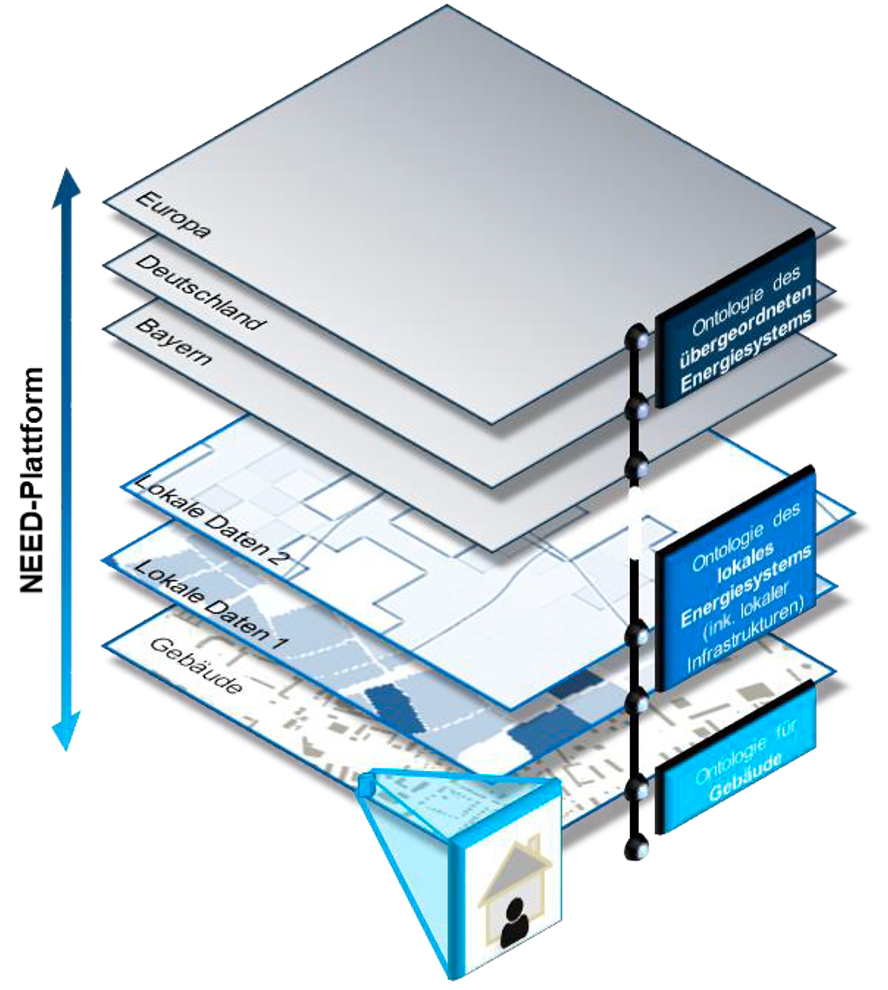
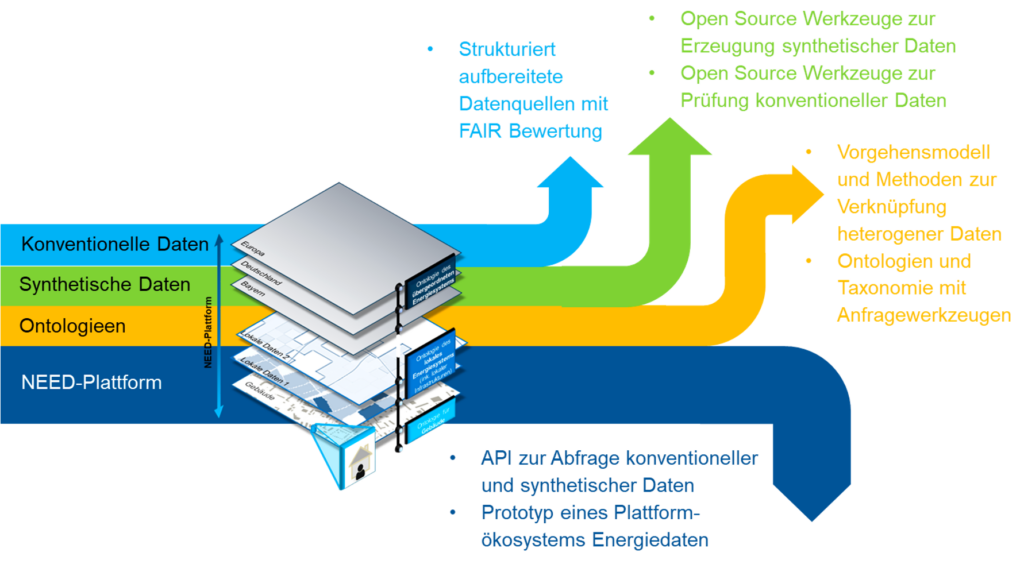
Innovation requirements of the research project
Discover how the NEED project is pioneering new methods in energy planning through innovative data integration and platform development. Learn about the creation of the NEED database, which combines conventional and synthetic data, the development of a decentralized data hub, and the implementation of advanced planning tools. Our project aims to revolutionize the way data is used and shared across different planning levels, paving the way for automated and interoperable energy solutions.
OGC Datasources
The OGC data sources provided here have been adapted for the NEED research project and are intended for project-related data provision, visualization, and testing. The data sources and their associated content are part of the project’s research activities and may be subject to change during the course of the project. No guarantee is given regarding the completeness, timeliness, accuracy, or continued availability of the provided data and services.
Project corresponding research
| Publication Name | Weblink | Release Date |
| An Open Source Pipeline for Estimating Residential Heating and Cooling Demands in Germany | BAUSIM2026 | September 2026 |
| Efficient topology design for district heating networks with multiple geographically distributed sources and limited supply capacities | ECOS26 | July 2026 |
| From Data Sources to Data Access: Core Components of an Energy Data Platform Ecosystem | DACH+ Conference on Energy Informatics 2026 | June 2026 |
| InfDB: An Open Source Energy and Infrastructure Data Ecosystem for Modeling and Planning | https://joss.theoj.org/papers/10.21105/joss.10458 | June 2026 |
| District Heating Pricing Schemes to Align Social Planning and Decentralized Decision-Making | https://doi.org/10.1109/EEM68581.2026.11589758 | June 2026 |
| A Multi-Agent System for Building-Age Cohort Mapping to Support Urban Energy Planning | https://doi.org/10.48550/arXiv.2603.17626 | March 2026 |
| HeatPrompt: Zero-Shot Vision-Language Modeling of Urban Heat Demand from Satellite Images | https://doi.org/10.48550/arXiv.2602.20066 | February 2026 |
| Generative Adversarial Synthetic Super-Resolution for Satellite Based Solar Panels Mapping | https://doi.org/10.1109/ACDSA67686.2026.11467855 | February 2026 |
| Automatisierte Erfassung von Dokumenten zur Recherche von kommunalen Wärmeplänen | https://doi.org/10.1007/978-3-658-50065-8_13 | January 2026 |
| Computationally efficient topology design of district heating networks by price-collecting Steiner trees | https://doi.org/10.1016/j.energy.2025.137223 | October 2025 |
| A Reproducible Open-Data Pipeline for Synthetic Low-Voltage Grid Generation in Germany | https://doi.org/10.30420/566656008 | October 2025 |
| Building a European-Level Energy Registry | https://fbi2025.rwth-aachen.de/ | September 2025 |
| Improved Machine Learning Hybrid Approach For Advanced Solar PV Power Forecasting | https://doi.org/10.1109/SusTech63138.2025.11025665 | June 2025 |
| Scalable and Interoperable Data Infrastructure in Energy Domain | http://dx.doi.org/https://doi.org/10.5281/zenodo.14961100 | March 2025 |
| Generation of low-voltage synthetic grid data for energy system modeling with the pylovo tool | https://doi.org/10.1016/j.segan.2024.101617 | March 2025 |
| Exploring the Potential of Freely Available Satellite Data for Energy Applications | https://zenodo.org/records/14843602 | February 2025 |
| A Platform Ecosystem Providing New Data For The Energy Transition | https://dl.acm.org/doi/10.1145/3717413.3717435 | February 2025 |
Our Partners















We gratefully acknowledge financial support through the project executing agency Jülich (PTJ) with funds provided by the Federal Ministry for Economic Affairs and Climate Action (BMWK) due to an enactment of the German Bundestag under Grant No. 03EN3077A.


Get in touch
Reach out for further information
Questions, information, collaboration